
Skip to content
SHAPE: Sexual Health Advanced Provider Education

Sexual medicine program, RSM Centre, University of British Columbia

Sexual medicine, taught for the clinicians patients actually see.

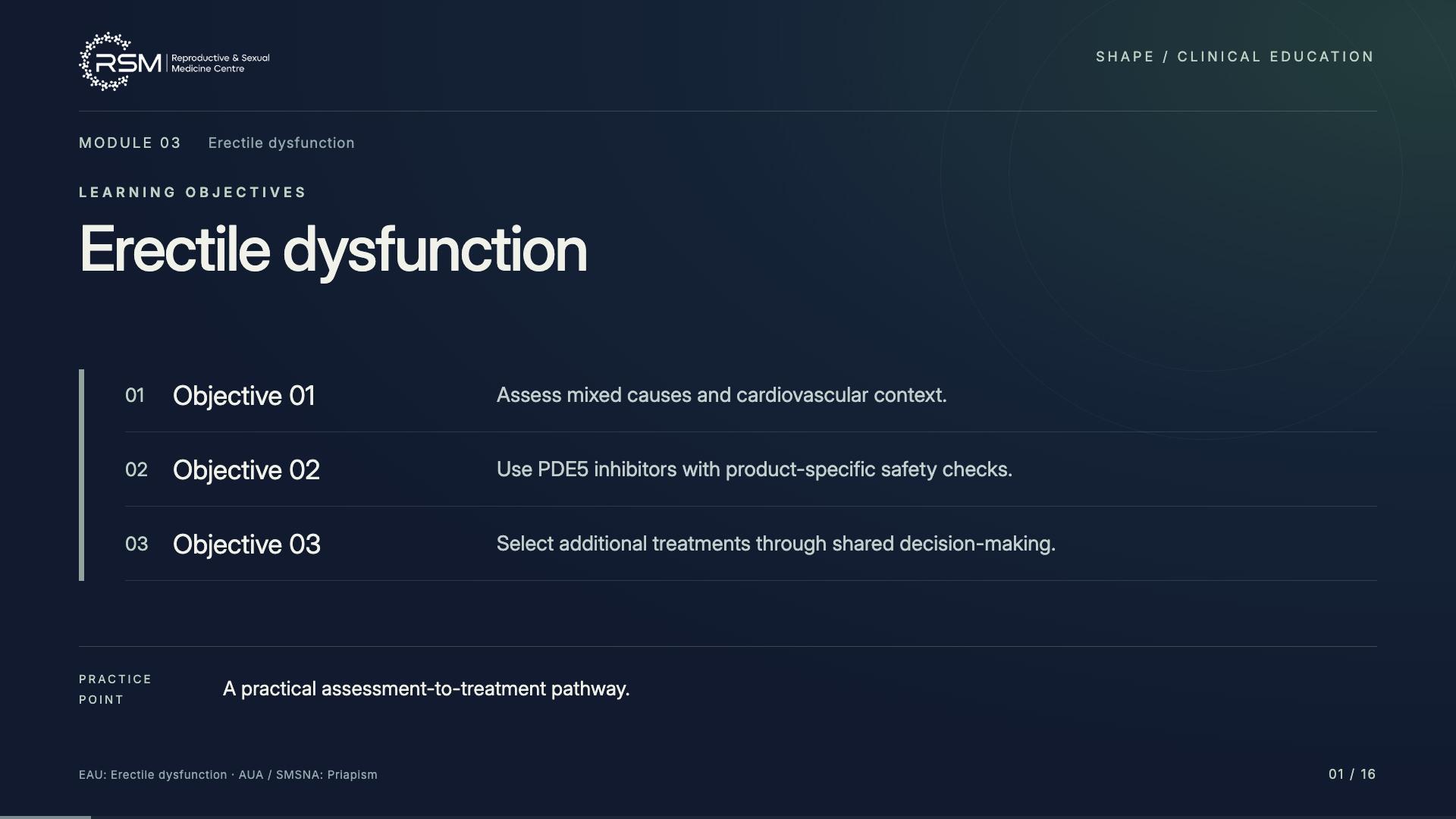
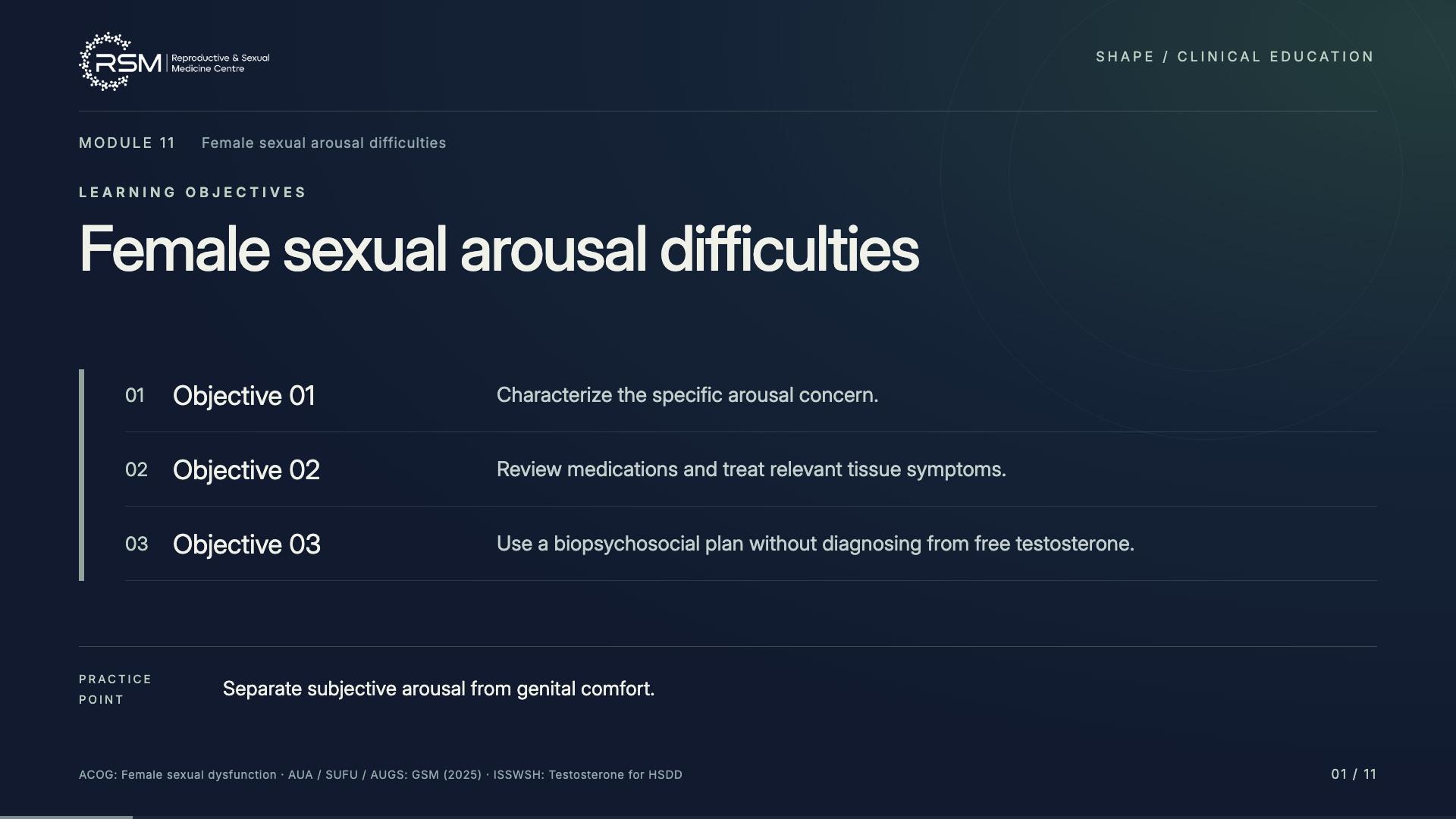
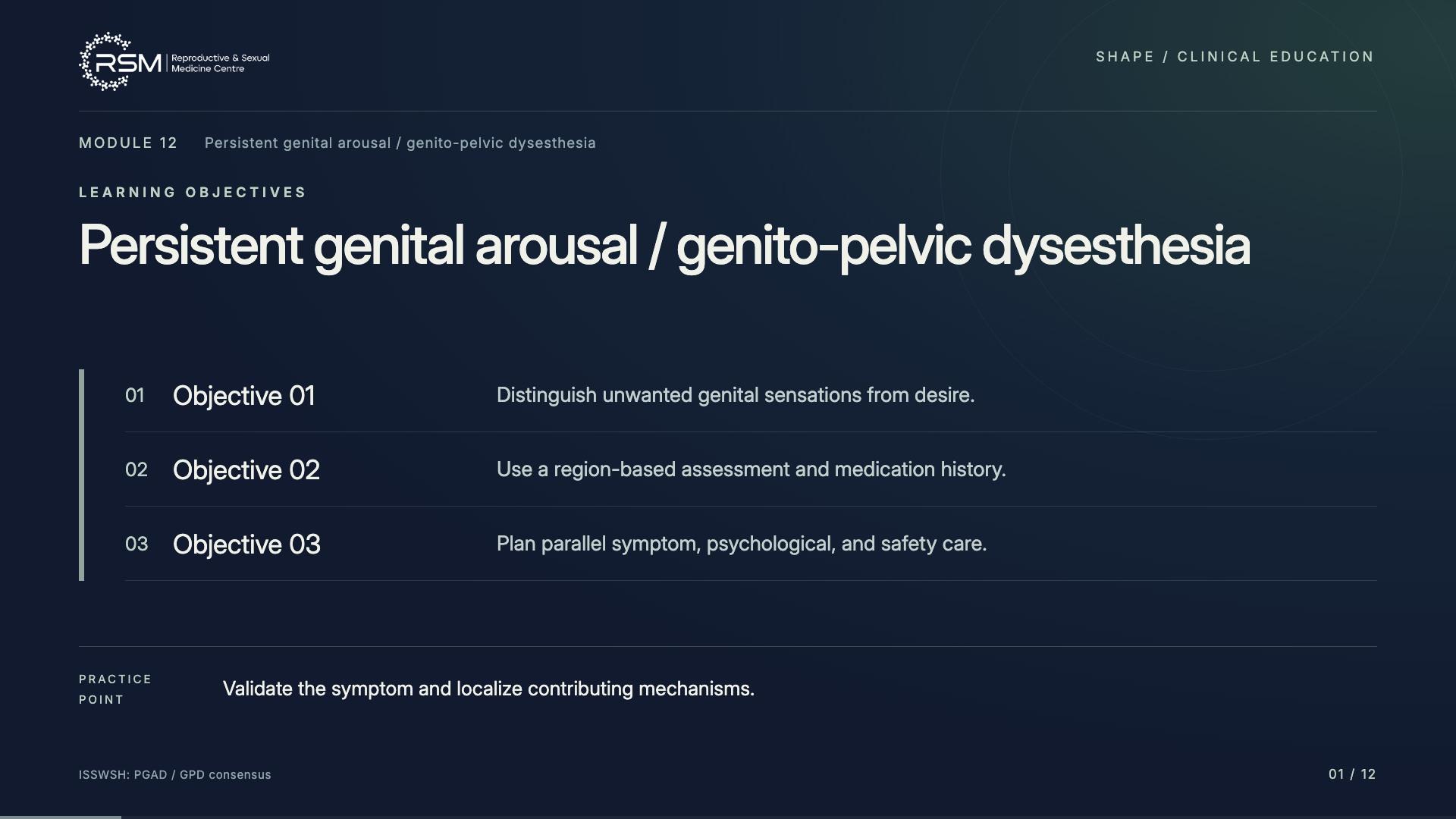
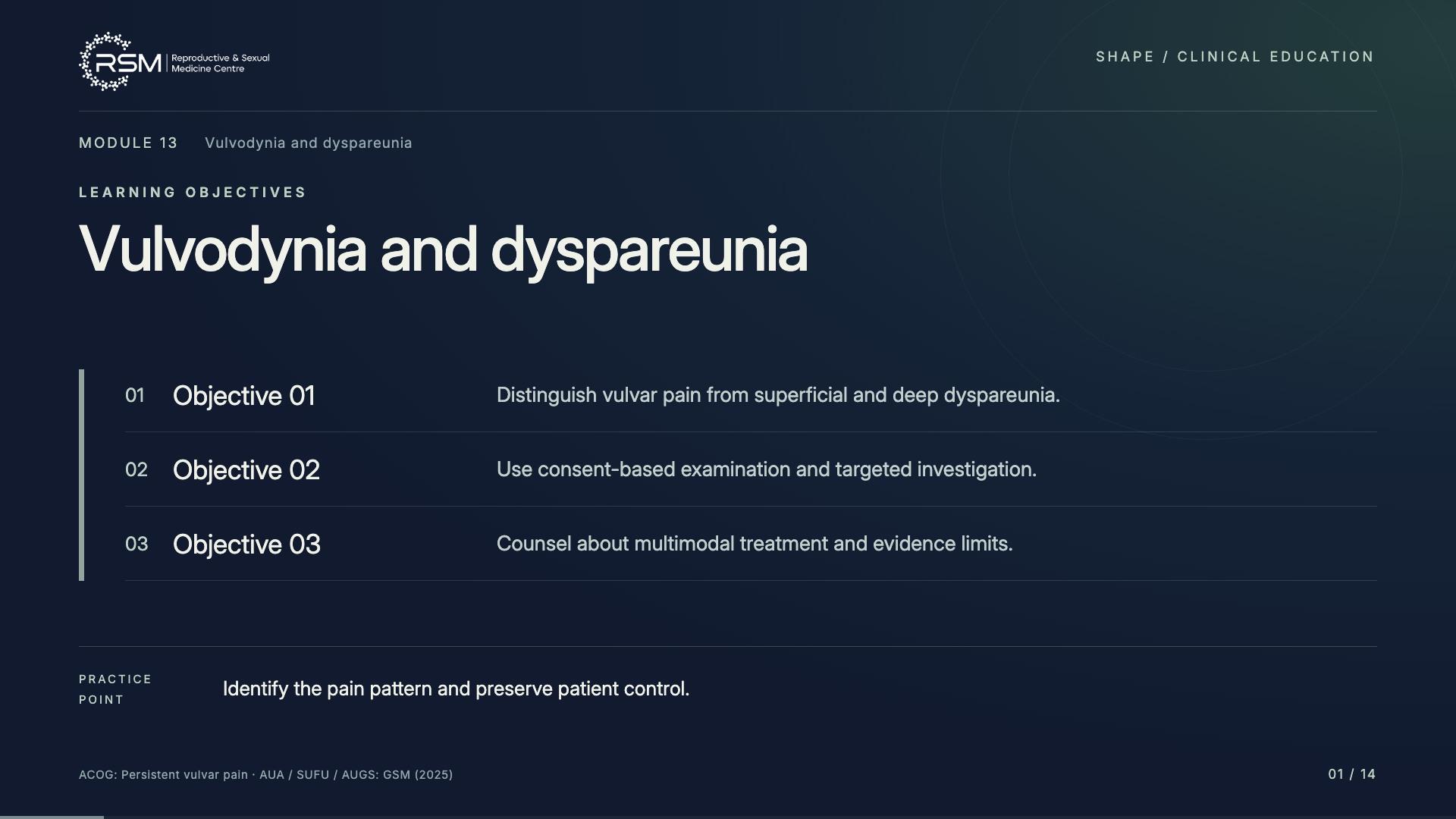
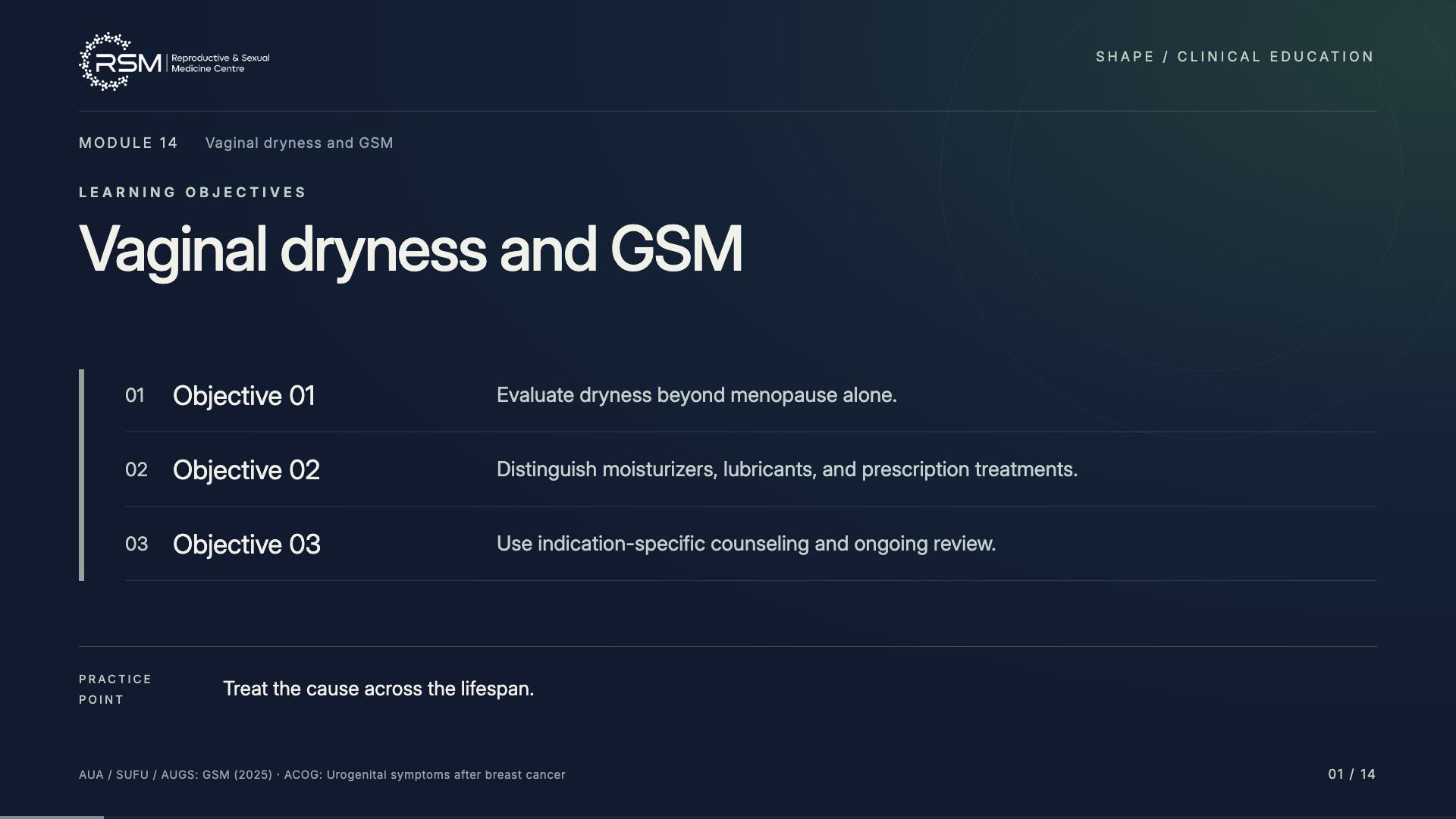
SHAPE is a twenty-module online program from the Reproductive and Sexual Medicine Centre at the University of British Columbia. Each module is a narrated lecture, a written lesson, a case, consultation tools and a referenced assessment, written by the Centre faculty for the physicians, psychologists, physiotherapists and allied health professionals who meet these concerns in clinic.

Modules
20
Assessment items
240
Consultation tools
9
Hours of learning
10.6
A quiet consultation room: two armchairs, a low wooden table and a tall plant by the window
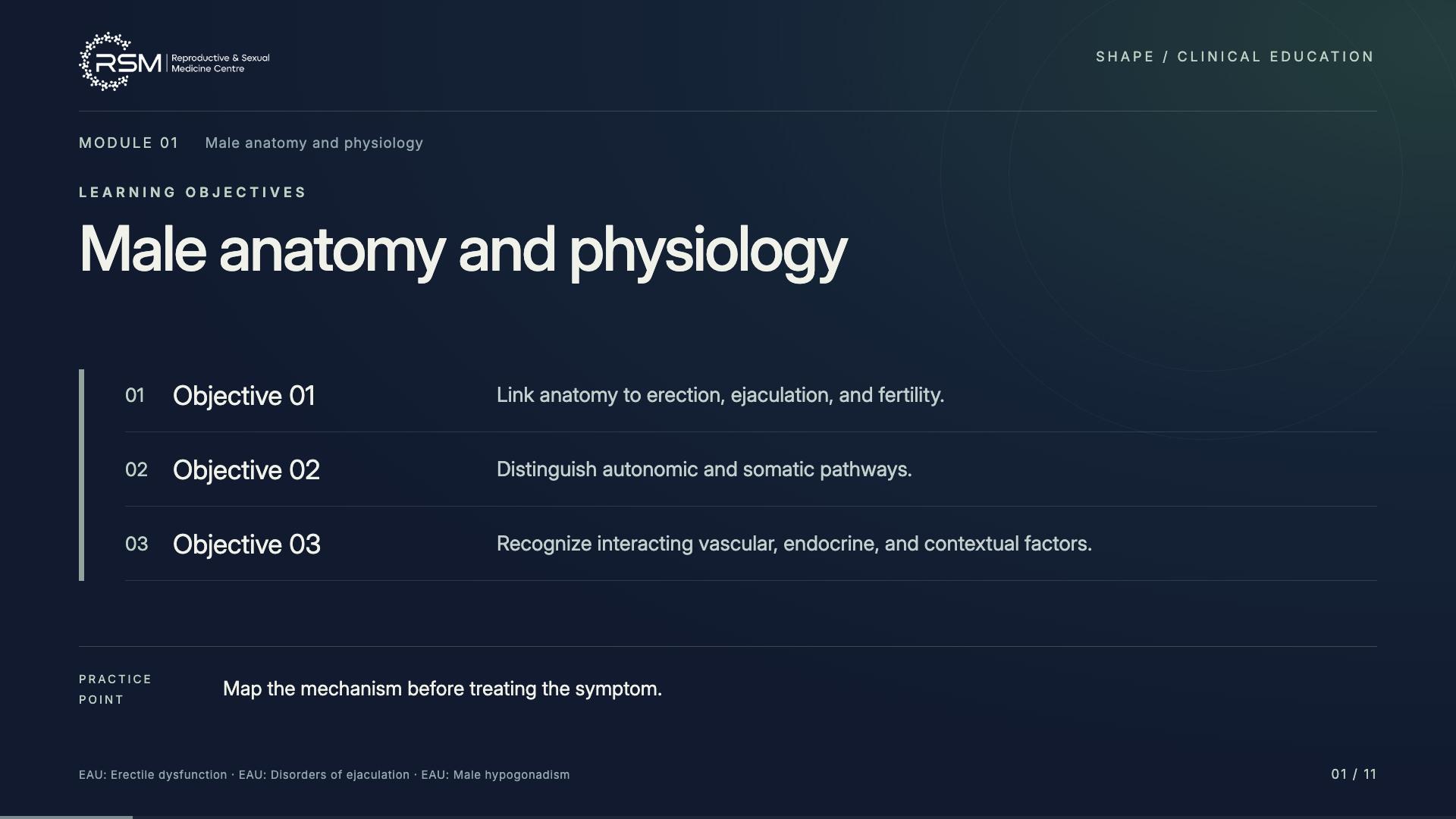
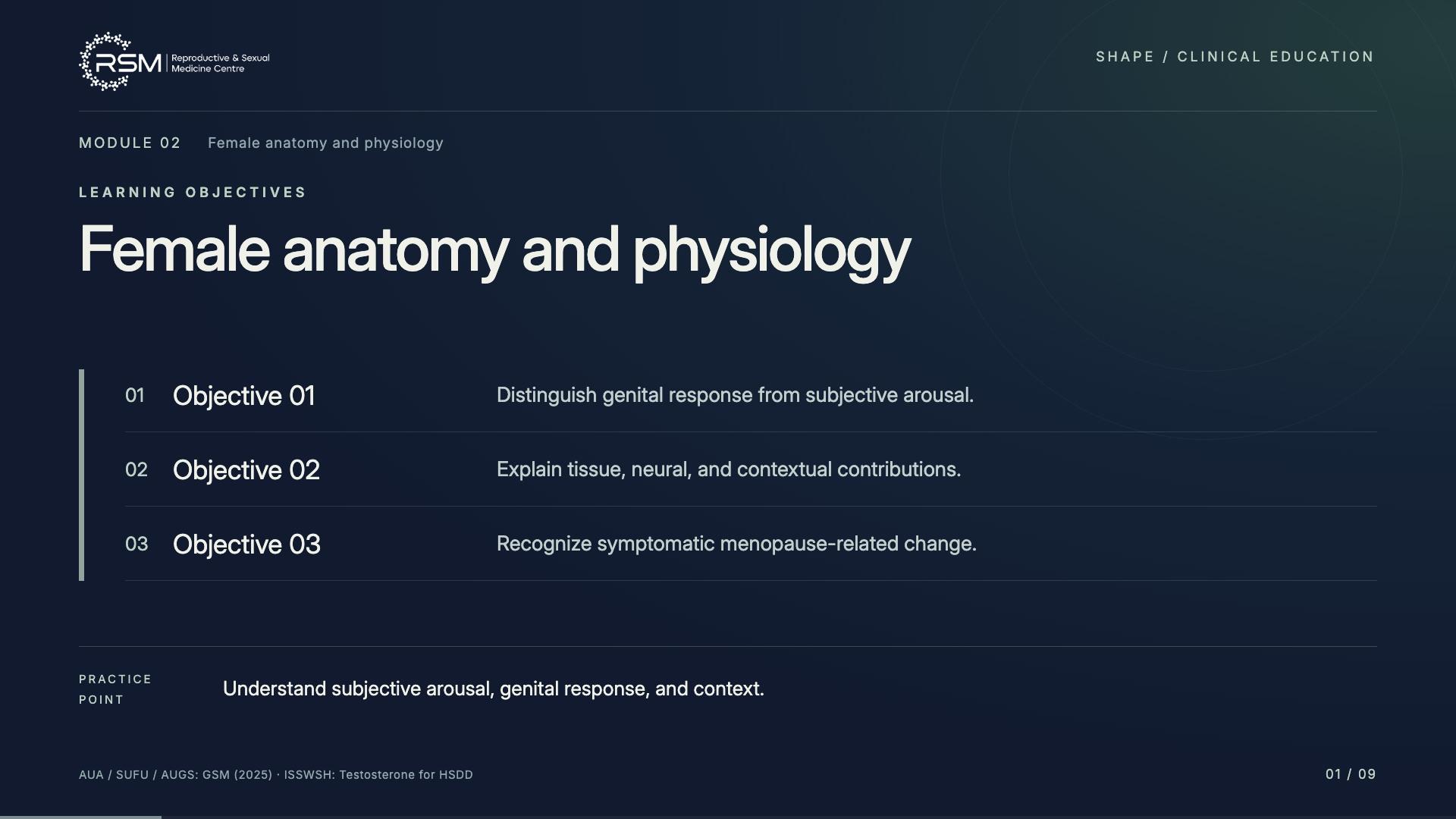
Program overview, one minute20 modules, 22 to 52 min each

Who it is for

Built for the whole sexual health team

Sexual health concerns arrive in every kind of clinic. SHAPE is written for the clinicians who hear them first and the specialists they refer to.

  • Urologists
  • Gynecologists
  • Psychologists
  • Primary care providers
  • Physiotherapists
  • Allied health professionals

How it works

Short modules, any order, one steady pattern

Twenty self-paced online modules of 22 to 52 minutes. Start with the group closest to your practice; the modules open in any order.

  • Self-paced, in any order

    Each module stands on its own. Your progress is saved step by step, so a module can be finished across several sittings.

  • Lecture, lesson, case, tools

    A narrated video lecture with its teaching screens, a written lesson with references, a case to work through and the consultation tools that belong to the topic.

  • A referenced assessment after every module

    The pass mark is 80 percent. Every answer is explained and cited, and an assessment can be retaken.

  • Narrated OSCE stations

    Clinical encounters that unfold one decision at a time, with patients who answer in their own voices and a debrief on the critical actions and the reasoning behind every step.

The twelve steps of every module

The same order in all twenty, so the pattern becomes familiar by the second module.

  1. Why this matters
  2. Learning objectives
  3. Pre-module check
  4. Video lesson
  5. Written lesson
  6. Key clinical decisions
  7. Case application
  8. Practice tools
  9. Assessment
  10. Answers and references
  11. Module evaluation
  12. Complete

Consultation tools

Nine tools for the consultation itself

Each tool turns a lesson into the questions to ask and the checks to make with the patient in front of you. They produce prompts for your assessment, never treatment clearance or doses, and they are included in the modules they belong to.

  • Tool 01

    Consultation planner

    Build a focused biopsychosocial consultation outline.

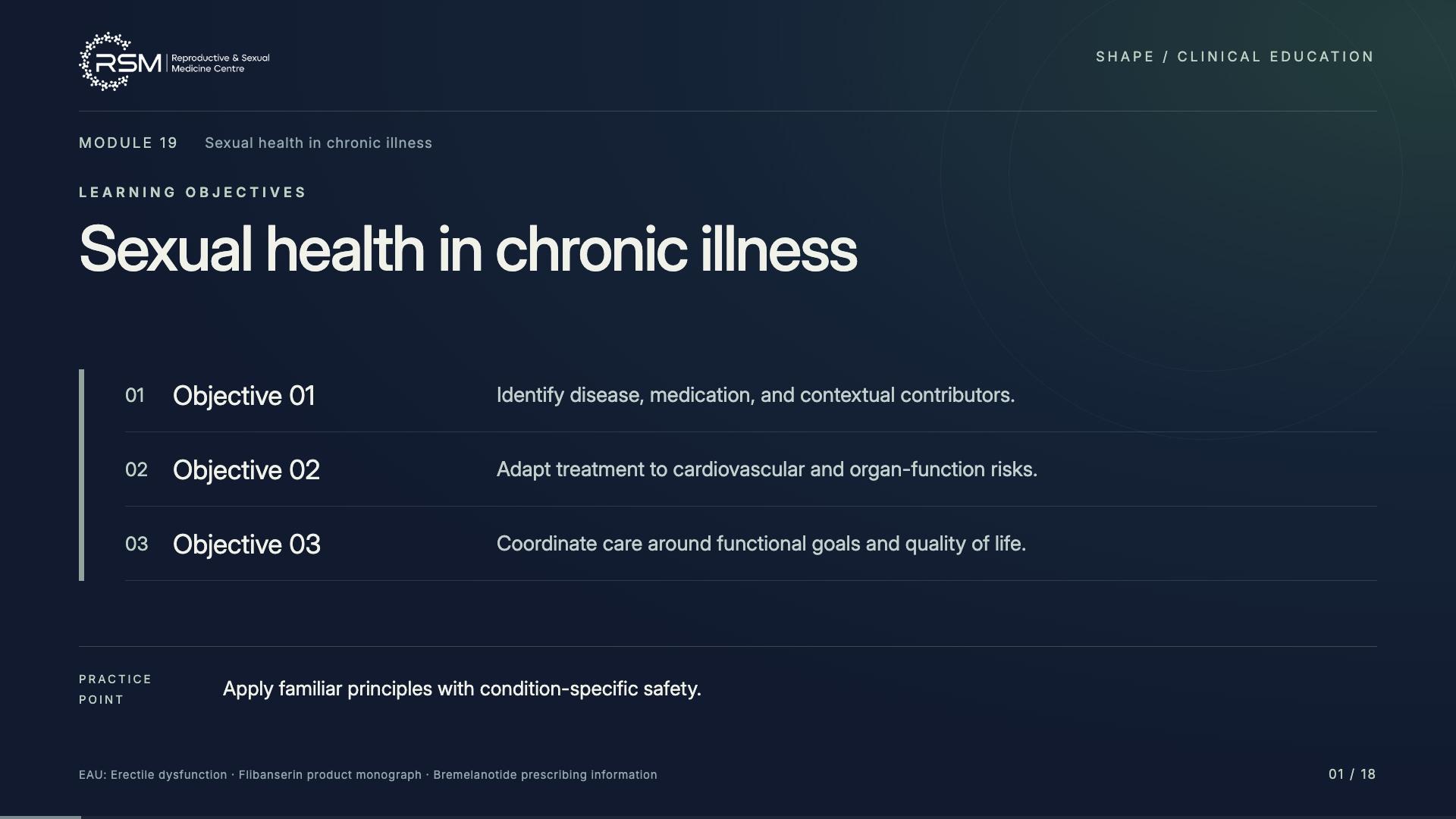
    Modules 1, 2, 6, 10, 11, 15, 16, 17, 18 and 19

  • Tool 02

    ED safety checkpoint

    Identify issues requiring action before a PDE5 discussion.

    Modules 3 and 19

  • Tool 03

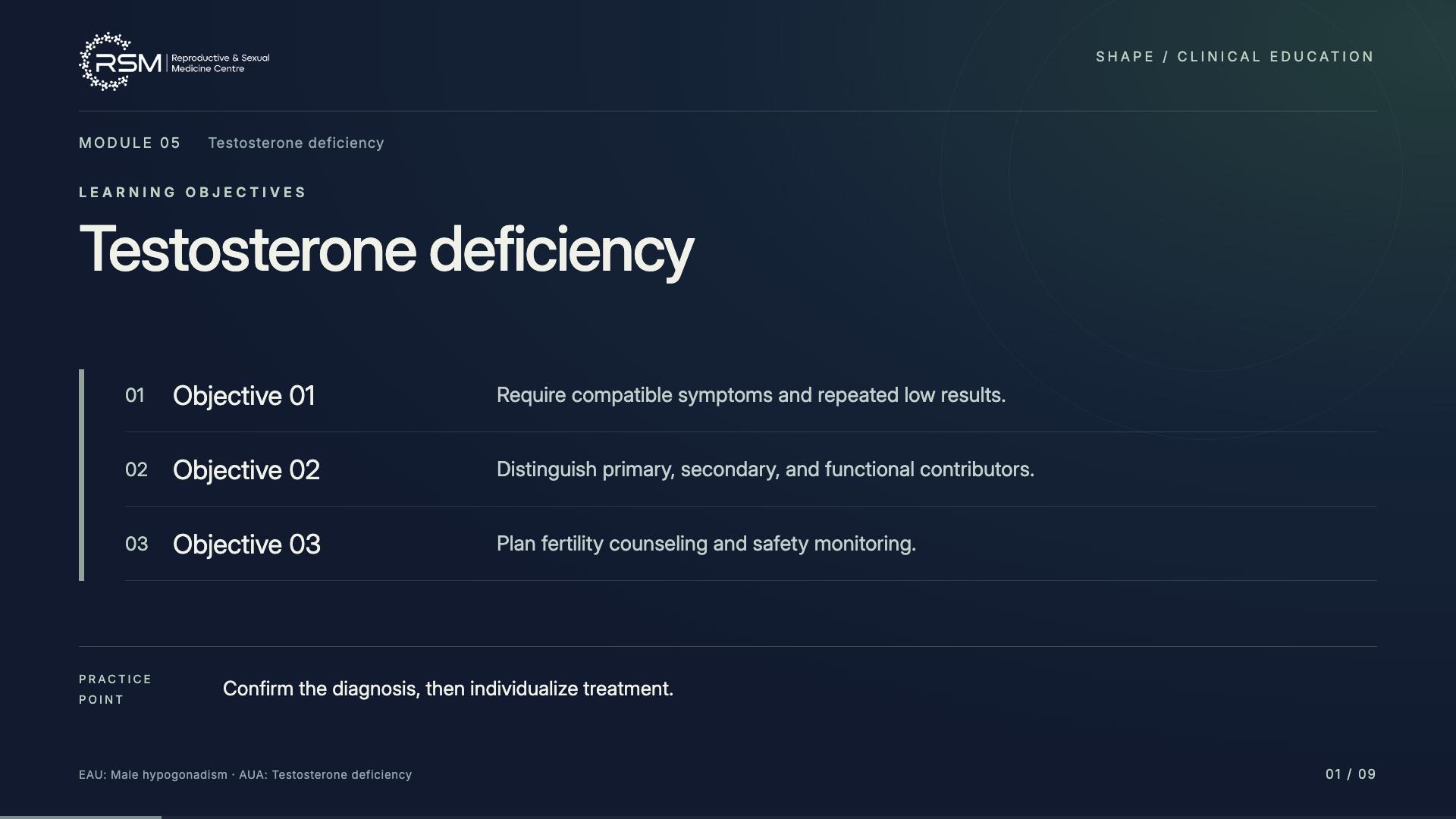
    Testosterone assessment checklist

    Review diagnostic prerequisites, fertility, and hematocrit.

    Modules 5 and 6

  • Tool 04

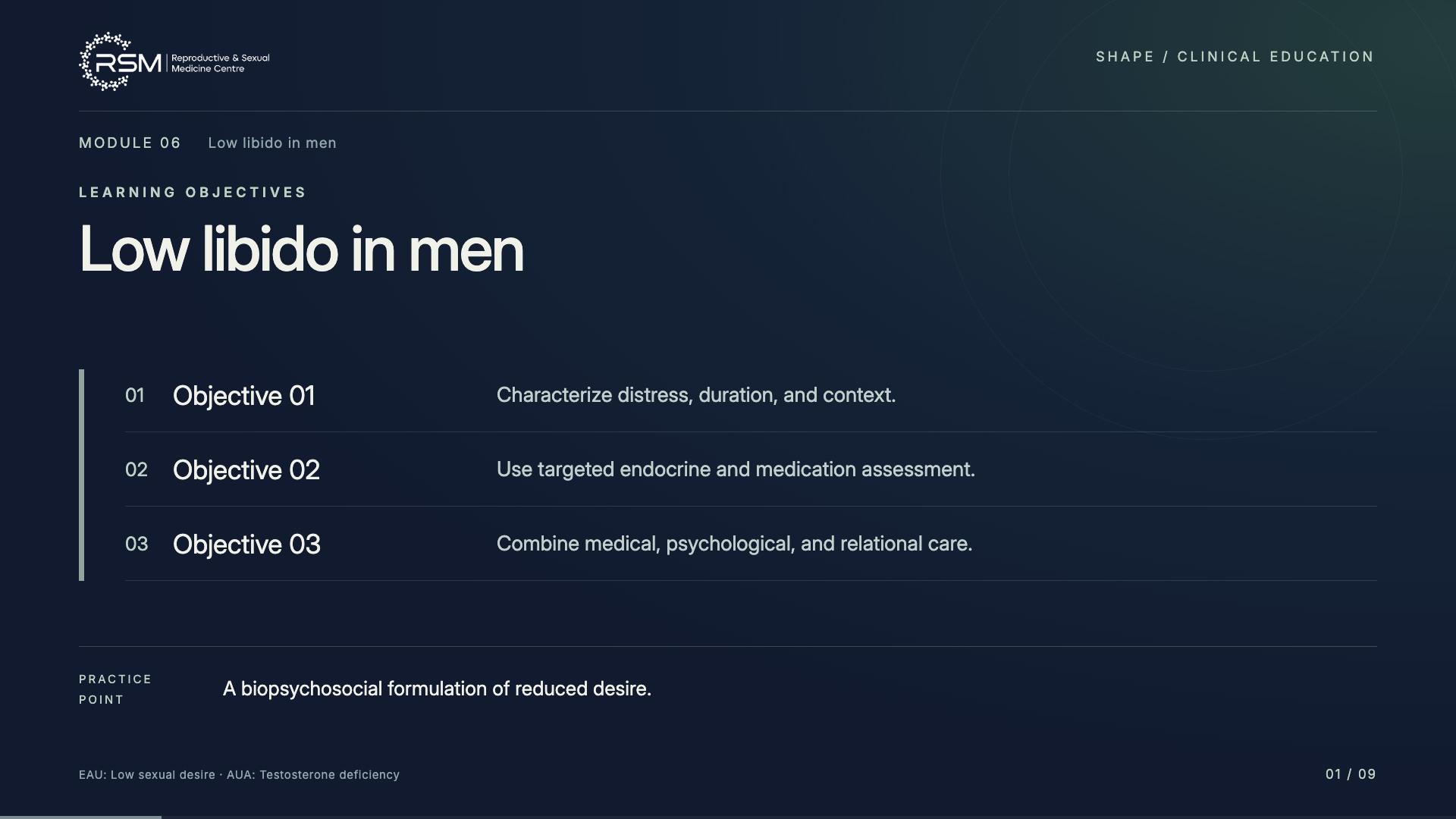
    Desire and arousal formulation

    Separate the concern, contributing domains, and treatment indication.

    Modules 6, 9, 10 and 11

  • Tool 05

    Orgasm and ejaculation map

    Generate assessment prompts without conflating climax and semen.

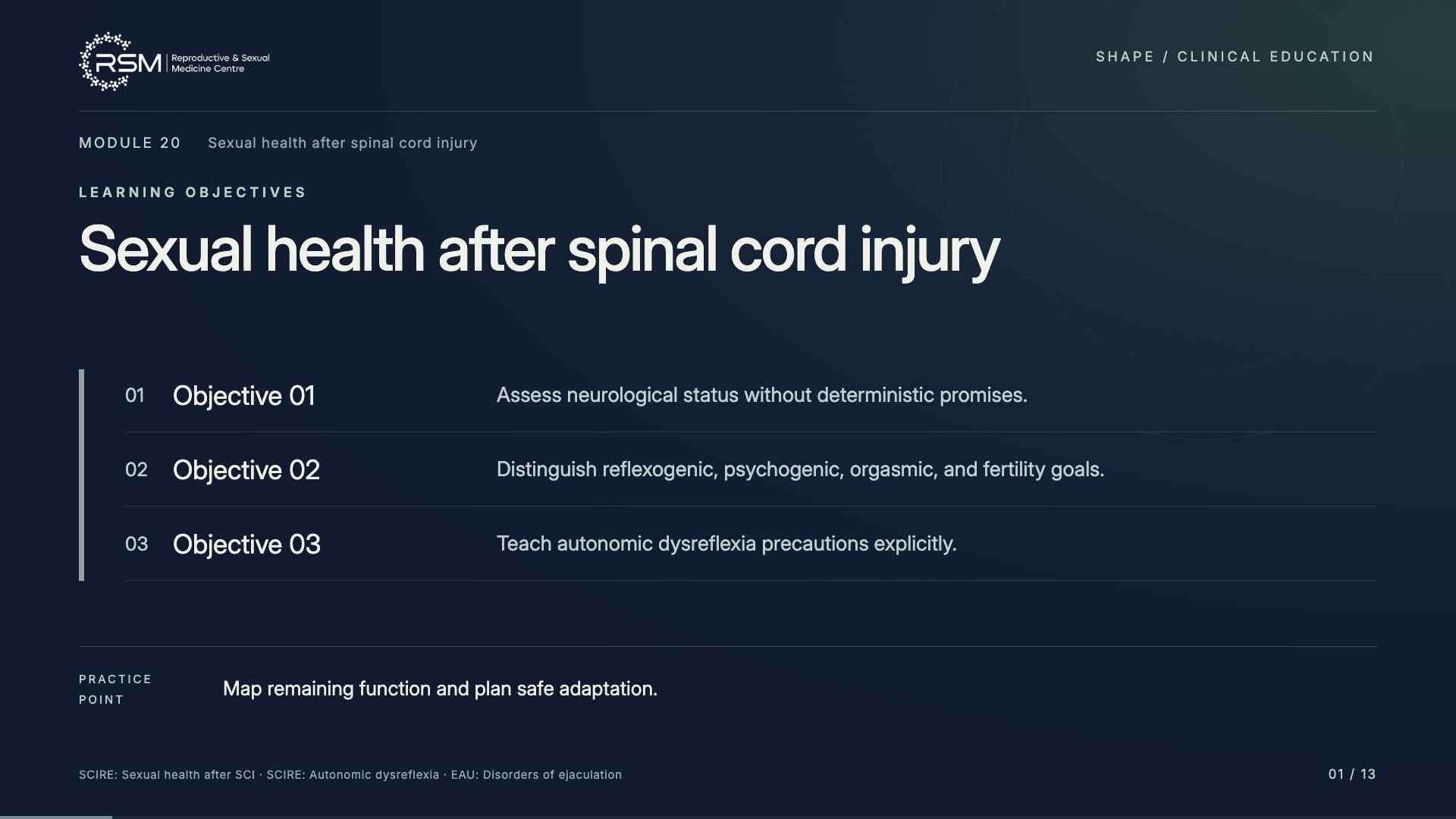
    Modules 7, 8 and 20

  • Tool 06

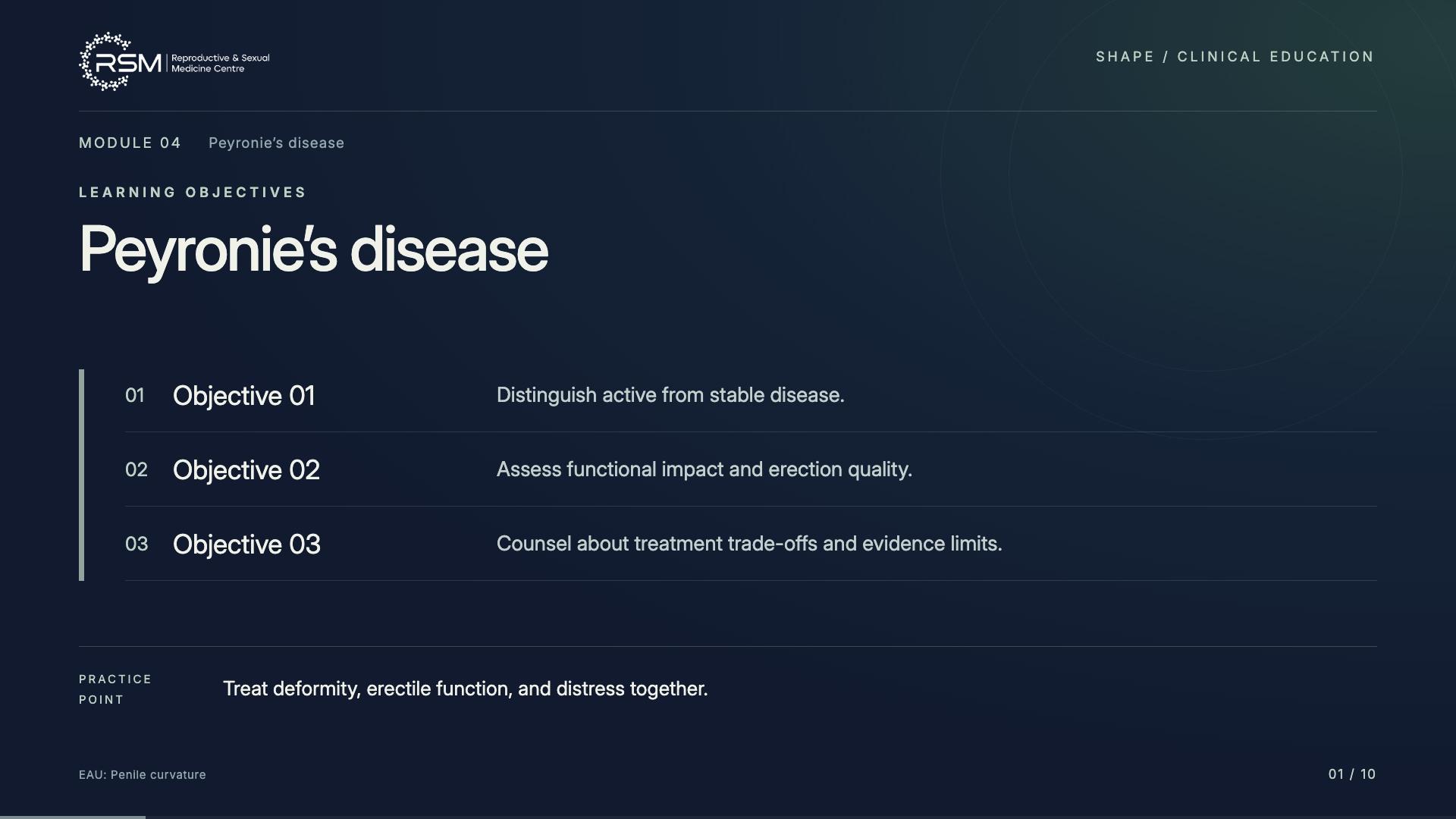
    Peyronie’s consultation guide

    Structure phase, function, and preference assessment.

    Module 4

  • Tool 07

    Sexual pain assessment map

    Organize a consent-based examination and differential.

    Modules 13, 14 and 17

  • Tool 08

    GSM treatment conversation

    Compare treatment categories and identify issues needing further review.

    Modules 2, 11, 14 and 18

  • Tool 09

    SCI sexual-health preparation

    Plan function, adaptation, and autonomic dysreflexia precautions.

    Module 20

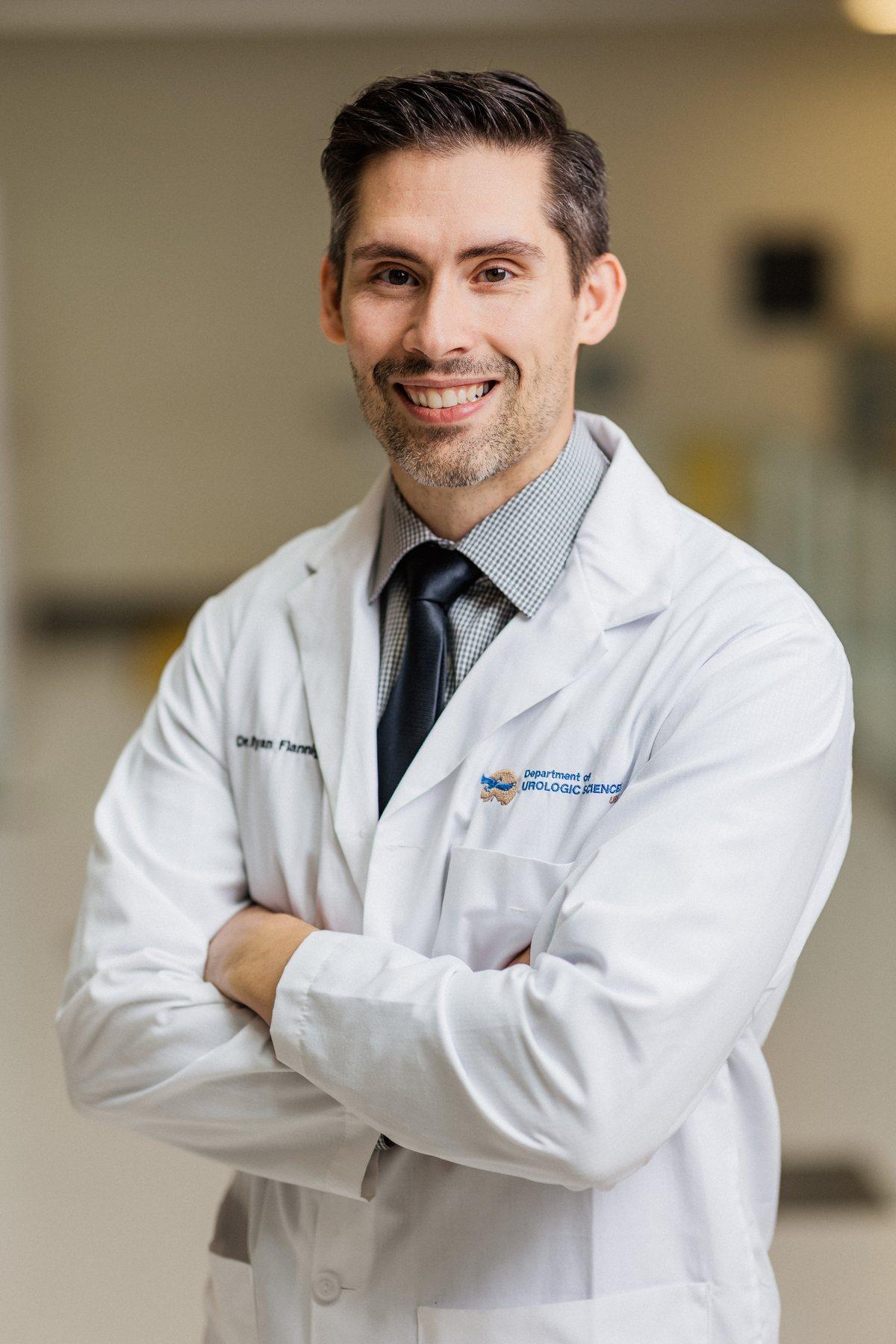
Dr. Ryan Flannigan

Centre Director

Dr. Ryan FlanniganMD FRCSC

Reproductive and Sexual Medicine Centre, University of British Columbia

Urologist and Director of the RSM Centre at UBC. The SHAPE curriculum was developed by the Centre faculty under his direction.

Contributing Faculty and Clinicians

Developed by the RSM Centre faculty

The Reproductive and Sexual Medicine Centre is a university centre for care, education and research in male reproductive and sexual health. SHAPE is its sexual medicine curriculum, written and recorded by the Centre faculty at the University of British Columbia.

  • Referenced throughout

    Each lesson carries its sources, and each assessment answer cites the guideline or study behind it.

  • Care that fits the patient

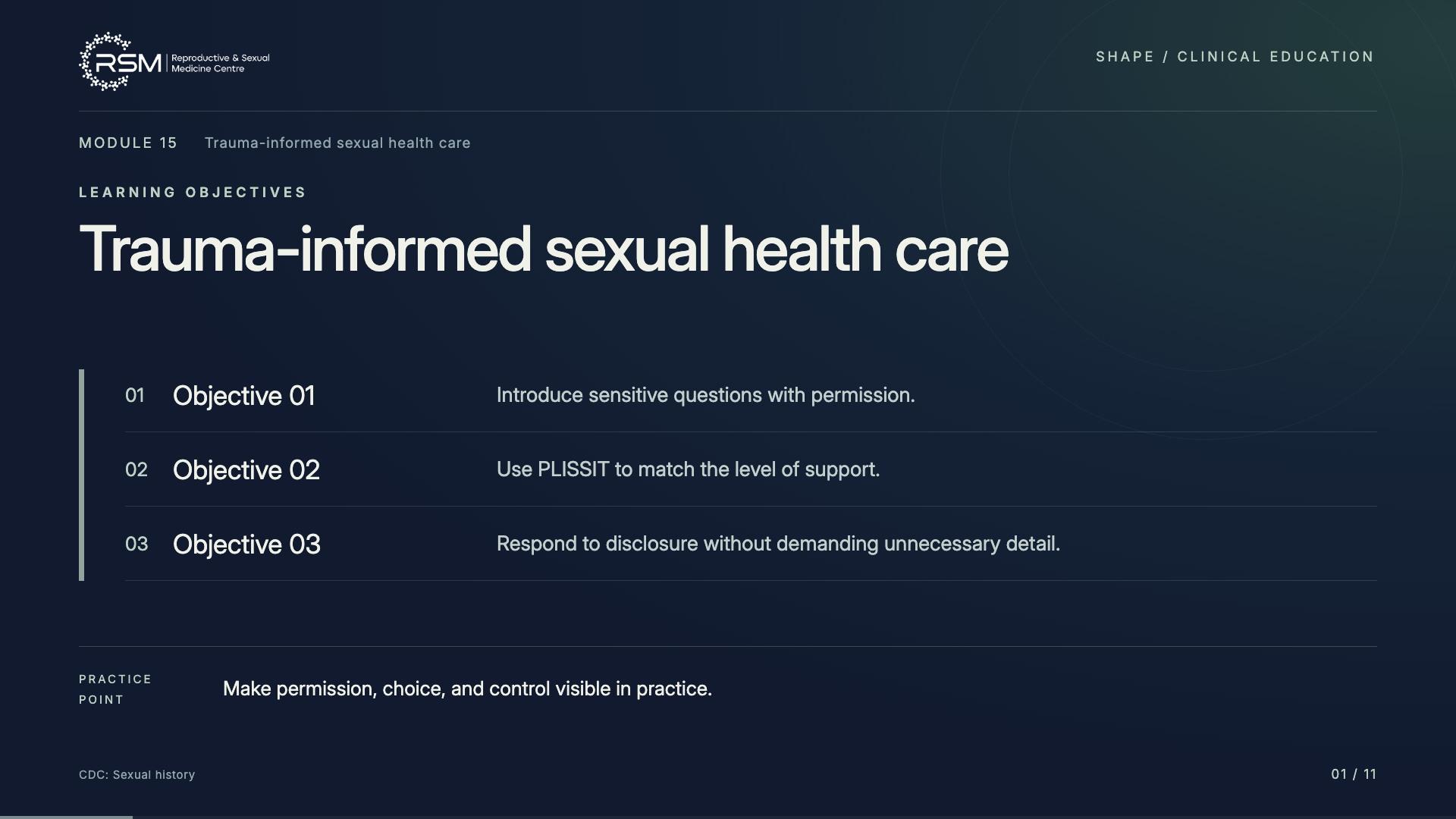
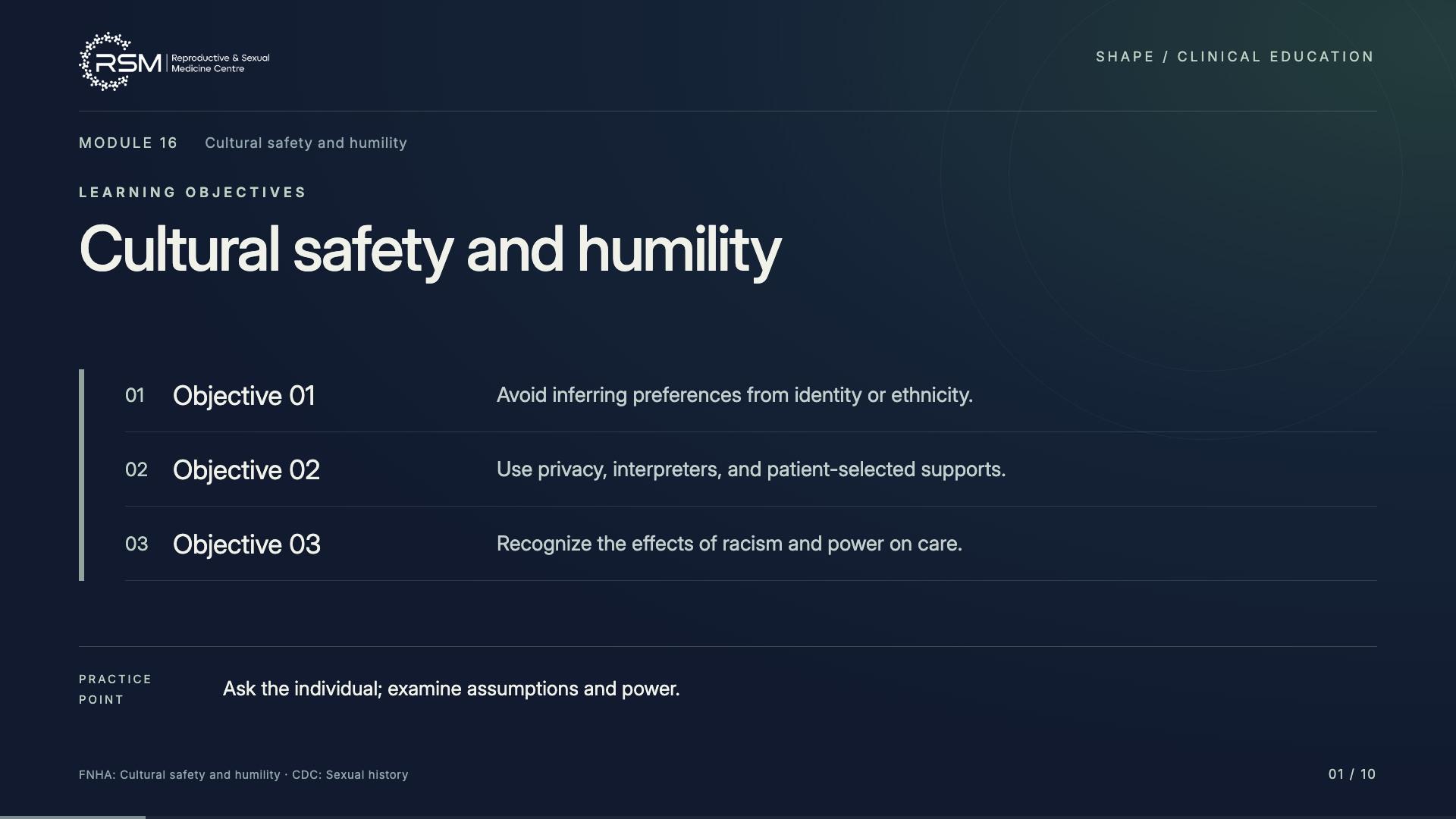
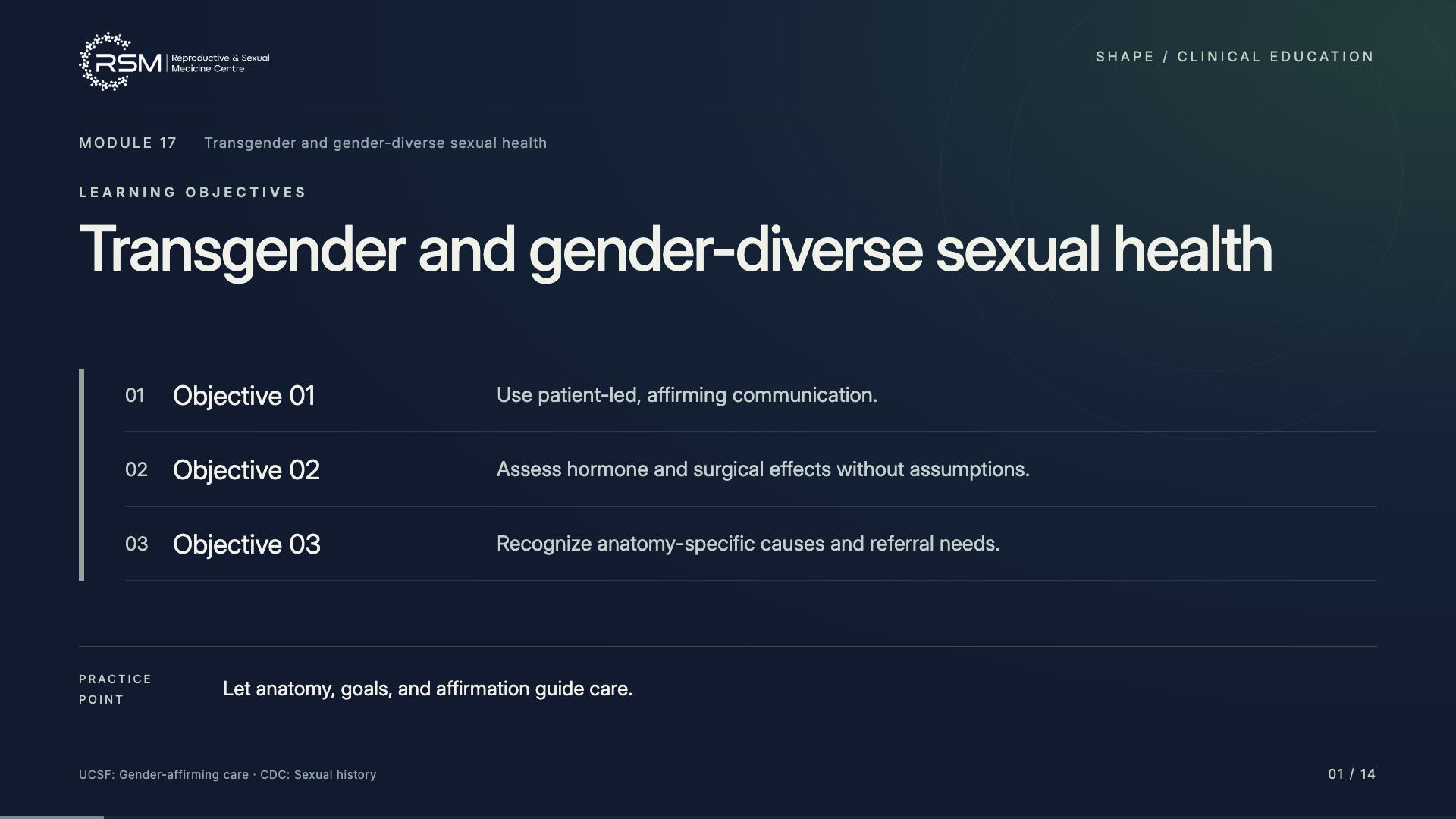
    Trauma-informed history taking, cultural safety and transgender sexual health have their own modules, and the consultation planner carries that approach into the modules it belongs to.

Contributing clinicians

  • Dr. Ryan FlanniganUniversity of British Columbia
  • Dr. Francisco GarciaSwift Current, Saskatchewan
  • Dr. Trustin DomesUniversity of Saskatchewan
  • Dr. Premal PatelUniversity of Manitoba
  • Dr. Jesse OryDalhousie University
  • Dr. Catherine McMartinUniversité Laval
  • Dr. Sarah BrinkUniversity of British Columbia
  • Dr. Matthew Mancuso
  • Dr. Justin ChanAndrology fellow, University of British Columbia
  • Jess Pinder
  • Justin Bhullar
  • Jenn Locke
  • Kate Anderson
  • Dr. Kiera LiblikQueen's University
  • Dr. Karim SidhomUniversity of Manitoba

The program

From the modules to your own clinic

The online modules and the OSCE are open today. Clinical preceptorship opportunities and ongoing mentorship through the RSM Network are in planning, with no dates set.

  1. Live

    Step 1

    Online education modules

    Self-paced modules of 22 to 52 minutes in five groups, each with a narrated lecture, a written lesson, a case, consultation tools and a referenced assessment. Designed to the Royal College Section 3 standard; no credit is claimed. Two narrated branching stations (erectile dysfunction, low desire in a woman) and two AI patient consultations (a man asking for testosterone, a woman with pain during sex), scored on critical actions with a debrief.

Every RSM program is built on the same educational model, the RSM SCALE Framework.

After the twentieth module

A certificate of completion, then a path into clinic

Finish the program and the record is yours. Learners who want more than the modules can apply for time with a specialist.

  • The certificate of completion

    Twenty modules, twenty assessments, one evaluation

    Complete all twenty modules, pass each post-module assessment at 80 percent or better, and submit the program evaluation. The certificate of completion is issued in your name and reads:

    Completion record

    Your name has completed SHAPE: Sexual Health Advancement for Provider Education, a self-directed online program of twenty modules with assessment.

    Your record carries your name as you entered it at sign-up.
  • Clinical preceptorship

    Time with a sexual medicine specialist

    After completing the program, learners may register for clinical preceptorship with sexual medicine specialists across Canada who have agreed to precept through the RSM Network.

Accreditation

SHAPE is designed to the Royal College of Physicians and Surgeons of Canada Section 3 standard. No credits are claimed for the program. The certificate of completion documents the modules and assessments you have finished.

Clinical use

SHAPE is professional education. Online learning does not replace clinical judgment, local protocols, or your own assessment of the patient in front of you. The consultation tools produce prompts for that assessment and never a treatment decision.